You do not need to know how to draw. In a guessing game, your job is to arrange simple marks so another person reaches the right idea. A neat illustration can help, but a fast silhouette with one distinctive detail often communicates sooner.
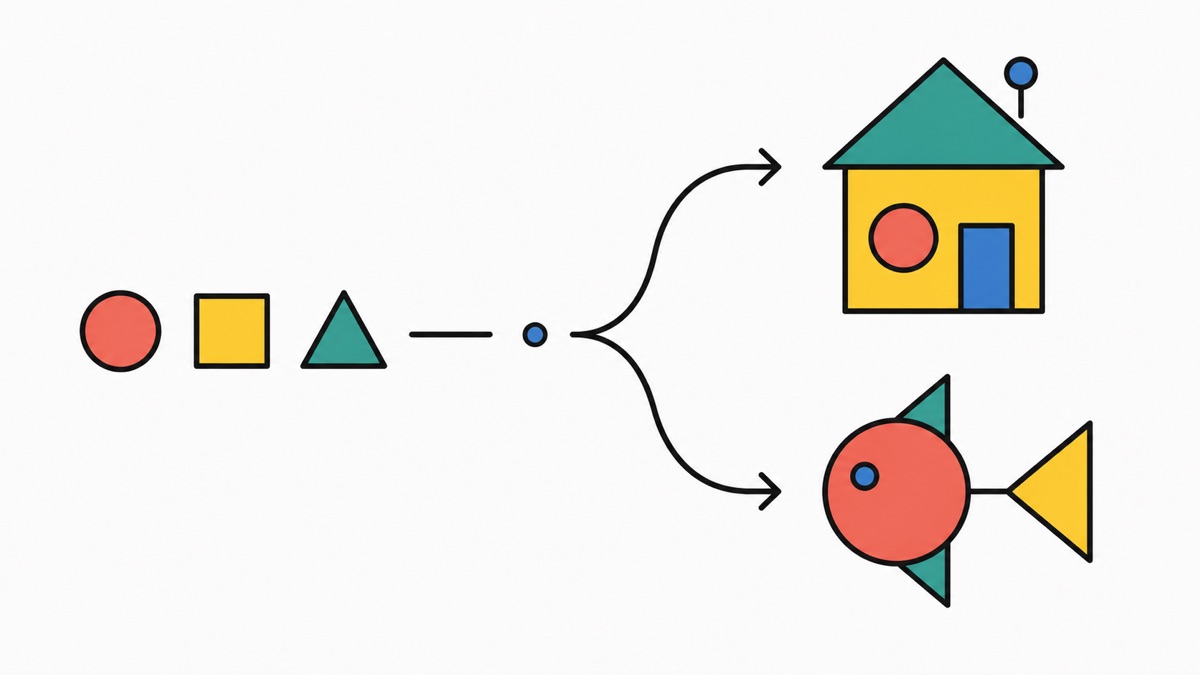
Use five basic building blocks: circle, square, triangle, line, and dot. Stretch them into ovals or rectangles when useful, but keep the underlying decision simple. Large forms establish the subject. Small marks separate it from nearby possibilities. Context shows what the subject does.
Circle: bodies, wheels, faces, and containers
A circle is the fastest way to suggest something round, but it begins with too many possible meanings. Add its relationship immediately. Rays turn a circle into the sun. A short stem suggests fruit. A face inside it turns the form into a head. A second circle and a frame can create a bicycle.
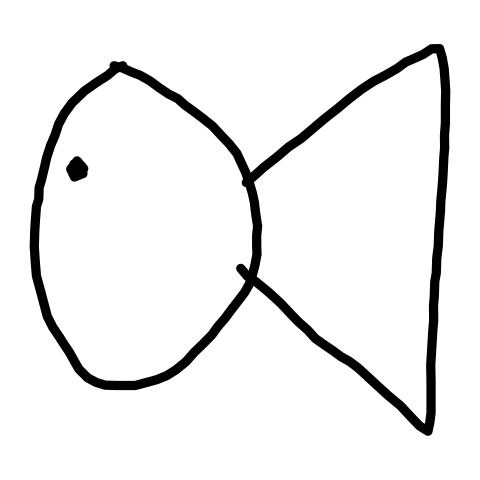
Stretch a circle into an oval for bodies and side views. A fish can be an oval with a triangle at the tail. A bird can be a small circle above a larger oval, with a triangle for a beak. A cup can begin as an oval rim above two vertical lines.
Circles are also useful as joints. Put dots or small circles at shoulders, elbows, and knees, then connect them with lines. The result is a stick figure whose pose is easier to control. Bend those connections to show running, sitting, reaching, or falling.
Square: buildings, screens, furniture, and packages
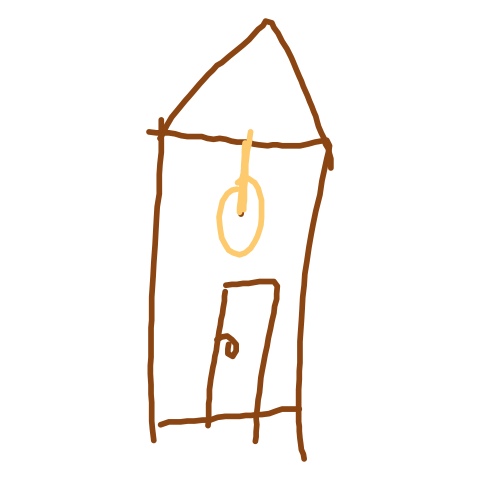
A square creates a stable object. Add a triangle on top and it becomes a house. Add smaller squares inside and it may become a window, building, or grid. Attach legs beneath it for a table. Put a handle on one side for a suitcase or cabinet.
The danger is that every box can look like every other box. Show function early. Hands over a lower rectangle make a laptop easier to read. Food inside a box can suggest an oven. A person sleeping beneath a large rectangle turns it into a blanket rather than paper.
Perspective is optional. A plain front view usually reads faster than a carefully drawn cube. If depth matters, add only one offset corner and connect it with short lines. Do not spend the whole turn trying to make every edge precise.
Triangle: direction, roofs, peaks, fins, and points
A triangle attracts attention because it points. Use it for a roof above a square, a mountain above a ground line, a sail above water, or a fin attached to a body. Two small triangles on a circular head quickly suggest animal ears.
Triangles also show direction. A repeated sequence can act like an arrow even when arrows are not the subject. A narrow triangle at the front of a shape can suggest a beak or nose. At the back of an oval, it becomes a fish tail.
Use the angle to separate similar clues. A wide triangle feels stable like a mountain or roof. A narrow triangle feels sharp like a needle, cone, or beak. The difference does not need mathematical accuracy. It only needs to be obvious on the canvas.
Line: movement, ground, limbs, and relationships
Lines connect the other shapes and tell the viewer how they relate. A horizontal line can establish the ground. Wavy lines make water. Diagonal lines create a slope, speed, or falling motion. Straight lines become limbs, handles, roads, rays, and boundaries.
A line can communicate action through direction. Put several short lines behind a moving object to show speed. Add curved lines above a hot object to suggest steam. Draw a dotted or curved path to show travel. These marks explain change without requiring a detailed scene.
Line weight matters less than clarity. Make the main outline bold enough to see on a small screen. Keep background lines lighter or fewer. If every mark has the same emphasis, guessers may not know which object is the subject.
Dot: eyes, texture, location, and emphasis
Dots are small but powerful. Two dots inside a circle create a face. A dot inside a larger form may suggest a button, seed, spot, or target. Repeated dots can create texture, but texture should come after the object is recognizable.
Dots also help direct attention. A cluster can show where an action happens, such as crumbs falling from food or bubbles rising through water. One dark point at the end of a line can become a pin, nose, or control.
Do not rely on tiny dots when players may be using phones. Enlarge any mark that carries the answer. A visible eye can separate a face from a ball. A large button can separate a device from a plain box.
Build familiar silhouettes
House: place a triangle over a square. Add a smaller square for a door and a pair of windows. Stop once the category is clear.
Fish: use an oval body, triangle tail, dot eye, and curved line for a mouth. Wavy lines around it establish water.
Car: draw a long rectangle with a smaller shape on top and circles below. Add ground and motion lines if the clue involves driving.
Person: use a circle for the head, a line for the torso, and angled lines for limbs. Change the joints to show action. Add one relevant object rather than detailed clothes.
Tree: combine two vertical lines for the trunk with overlapping circles for leaves. Fruit dots, a swing line, or a person beside it can clarify scale or use.
Boat: make a shallow curved hull, triangle sail, vertical mast, and wavy water. A paddle and seated figure can separate a canoe from other boats.
Draw category, difference, and context
Use a repeatable order. First draw the category: animal, person, object, place, or action. Next add the feature that separates the answer from close neighbors. Finally, add context that shows where it belongs or how it is used.
For a cat, the category is animal, the difference may be pointed ears and whiskers, and the context might be a small bowl. For a hammer, the category is tool, the difference is the heavy head, and the context is a nail entering wood. Each layer narrows the interpretation.
If guesses move in the wrong direction, do not simply redraw the outline. Add a different kind of information. A person using the object, a setting, or a contrasting object can change the category faster than extra detail.
Show actions with before and after
Some verbs resist a single frozen pose. Divide the canvas loosely into two scenes. Show a closed object, then an open one. Show a person in one location, then the same person elsewhere with a path between. The contrast communicates change.
Arrows can make direction obvious, but the scene should still carry most of the meaning. Movement lines, body angle, and destination give guessers more to work with. If the target is jumping, bend the legs and leave space between the feet and ground.
Practice without becoming an artist
Pick an ordinary object around you and reduce it to the five shapes. Ask which feature makes it different from neighboring objects. Then sketch the setting where someone would use it. This practice builds clue judgment, not drawing polish.
In a live round, commit to large marks and revise through context. The canvas does not need to look realistic. It needs to guide another mind from a broad category to one answer. Five simple shapes can do that when every mark has a reason.
Try the five-shape method in a round.
🎨 Play Rakuga