What makes a word hard to draw? Vocabulary seems like the obvious answer, but real play points somewhere else. Across 27,944 Rakuga games, ordinary objects repeatedly caused complete misses. Players knew the words. The problem was converting those words into marks that looked distinctive before the timer ended.
The English results make that pattern easy to see. Towel, shield, screwdriver, island, and blanket each had a 100% rate of rounds in which nobody guessed correctly within the measured sample. Violin followed at 90%, microwave at 89%, and ninja, monkey, gymnastics, and doll each reached 88%. Skiing, laptop, and fire truck came in at 86%, while yoga reached 83%.
The hardest English clues in the data
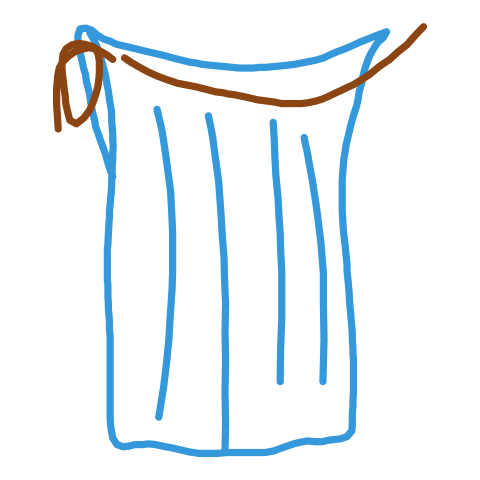
- Towel, 100% missed: a rectangle can look like paper, a rug, a door, or a blanket.
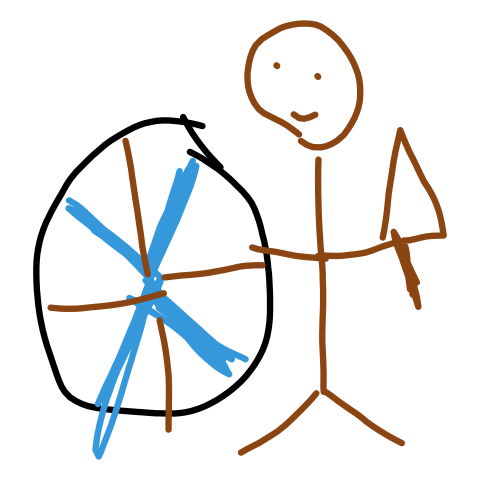
- Shield, 100% missed: its outline changes by style, and without a person it lacks context.
- Screwdriver, 100% missed: the narrow tool can resemble a pen, needle, or stick.
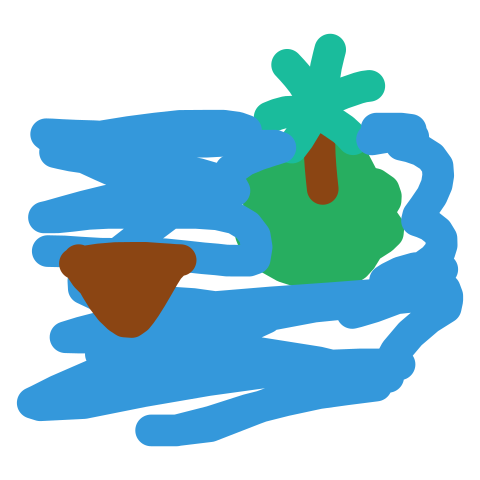
- Island, 100% missed: water around a shape may suggest a lake, beach, or map.
- Blanket, 100% missed: fabric has almost no fixed silhouette when drawn alone.
- Violin, 90% missed: its curves and bow need careful proportion to separate it from other instruments.
- Microwave, 89% missed: a box with a window can become an oven, television, or cabinet.
- Ninja, 88% missed: a masked figure depends on clothing, pose, and an action clue.
- Monkey, 88% missed: a quick animal outline can be mistaken for a person or another mammal.
- Gymnastics, 88% missed: an activity requires motion, equipment, or a recognizable pose.
- Doll, 88% missed: a small human figure looks like a child unless scale is made clear.
- Skiing, 86% missed: the action needs a slope, skis, poles, and a readable body angle.
- Laptop, 86% missed: two hinged rectangles can look like a book or an open box.
- Fire truck, 86% missed: a vehicle needs the right emergency details without becoming a generic truck.
- Yoga, 83% missed: a pose alone may look like stretching, dancing, or exercise.
Silhouette matters more than familiarity
A strong drawing clue has a shape that excludes alternatives. A weak clue shares its outline with many unrelated things. That is why a towel can be harder than a more specific object. Everyone recognizes a towel in life because texture, folds, location, and touch provide information. On a blank canvas, most of those signals disappear. What remains is a plain rectangle.
Island creates a similar trap. The drawer may make a mound surrounded by blue, but the guesser sees several plausible scenes. It might be land, a beach, a lake edge, or even food on a plate. Adding a palm tree can help, yet that may redirect guesses toward vacation or beach. A useful clue must narrow the category without replacing the target.
Shield looks distinctive in the drawer's mind because the imagined object has metal, weight, and a familiar heroic setting. A simple outline does not carry those qualities. Add an arm behind it, a person holding it, and something bouncing away from its surface. Context turns an uncertain outline into a function.
The canoe pattern across languages
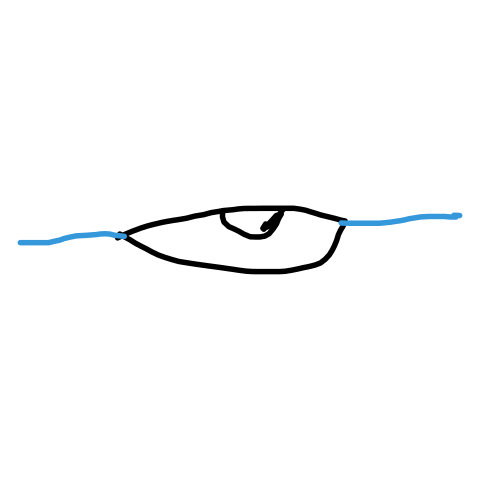
One result appears across several language groups. The same object reaches the difficult group as canoa in Italian, kano in Turkish, 카누 in Korean, and canoe in the broader cross-language pattern. The exact spelling changes, but the visual problem stays put. A canoe is a long curved form that can look like a banana, bowl, smile, crescent, or ordinary boat.
This cross-language repeat matters because it removes vocabulary as the main explanation. Players are not all struggling with the same spelling. They are struggling with the same silhouette. A canoe becomes readable when the drawer adds a seated person, a paddle touching water, a pointed hull, and perhaps a second bank line. The scene shows how the object is used.
Three families of hard words
Generic forms include towel, blanket, laptop, microwave, and shield. Their first outline is a rectangle, box, or curve shared by many objects. These clues need a functional detail early. Draw the towel hanging from a rail, the blanket covering a bed, or the laptop with hands over a keyboard.
Actions and poses include skiing, yoga, and gymnastics. A frozen body can communicate many verbs. The best route is to draw the environment and the direction of movement. A slope below skis, a mat below a yoga pose, or a bar beside a gymnast gives the body a reason to be positioned that way.
Category lookalikes include violin, monkey, ninja, and fire truck. The guesser can identify the broad family but miss the precise answer. The drawer should focus on the feature that separates close neighbors: a bow beside the violin, a curling tail and climbing pose for the monkey, a mask with a stealthy posture for the ninja, or a ladder and emergency light on the truck.
A better way to draw a difficult clue
Start by asking what wrong answer your first shape will attract. If the answer is towel and you draw a rectangle, expect guesses such as paper or carpet. Your next mark should eliminate those options. A rail, a folded corner, or a hand drying itself carries more meaning than extra shading.
Then add context before decoration. Color is useful only when it separates the target. Texture marks can make a towel look fuzzy, but a bathroom scene communicates faster. A metallic shine on a shield may be attractive, but an incoming arrow tells the viewer what the object does. Function is usually the strongest second clue.
Finally, keep the drawing large. Hard silhouettes become harder when they occupy a small corner of the canvas. A big outline leaves room for the handle of a screwdriver, the keys of a laptop, or the strings of a violin. The goal is not realism. It is a sequence of decisions that removes competing answers.
What guessers can learn from the same data
Guessers should treat generic shapes as open categories. A rectangle is not a failed clue. It is the beginning of a family that may include fabric, screens, furniture, tools, or buildings. Watch what touches the shape, how a person interacts with it, and where it sits in the scene.
For action clues, name the broad movement early, then refine it. If a figure bends, try exercise words. If the drawer adds equipment, shift toward a sport. If the background becomes a slope or mat, update the guess again. Incremental guessing is more effective than waiting for a polished image.
The data does not say that difficult words are bad prompts. They often create the most memorable rounds because they force drawers to communicate through context. A hard word becomes fair when the clue is built around use, motion, and contrast. When the silhouette is weak, draw the relationship around the object.
Put these clue ideas into practice.
🎨 Play Rakuga