
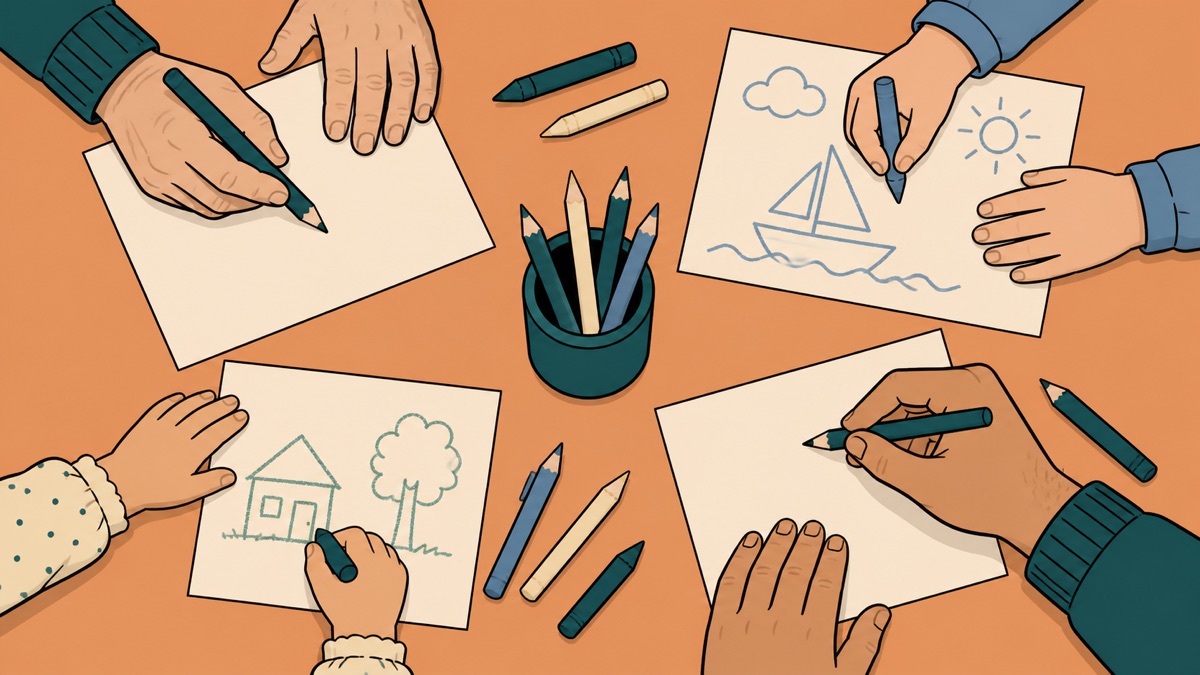
Drawing games are a strong choice for family game night because the rules can be explained through play. Someone draws, everyone else tries to understand, and the funniest moments come from sincere attempts rather than polished skill. Children can surprise adults with direct visual thinking, while adults often overcomplicate a simple clue.
A mixed-age group still needs thoughtful rules. Reading speed, device comfort, vocabulary, and fine motor control can create hidden advantages. The best family format changes partners, alternates paper with online play, and rewards clear communication more than a final ranking.
Start with a shared expectation
Tell everyone that recognizable drawings are better than beautiful ones. No teasing a person for drawing slowly or differently. Laugh at the surprising interpretation, not at the artist. This small distinction keeps younger players willing to try again and gives hesitant adults room to be playful.
Agree on basic clue rules before starting. Writing the answer removes the puzzle, so use shapes and scenes instead. Decide whether letters, numbers, gestures, or spoken hints are allowed. Simple rules are easier to remember than a long list of exceptions.
Keep the first round easy enough for everyone to understand the loop. Use familiar categories and let a confident volunteer draw first. Once the family sees how guesses appear and points work, more complex turns feel less intimidating.
Mix online play with paper
An online private room gives the night a steady structure. Rakuga works in a browser without an account, and family members can join from phones, tablets, or computers. Use the invite link to keep the room with your group. The game handles turns and scoring while everyone shares the same canvas.
Paper rounds change the physical rhythm. Put a stack of scrap paper and broad markers in the middle. One person draws while teams call out guesses or write them on small cards. Broad pens discourage tiny detail and help the picture stay visible across the table.
Alternate the formats when attention starts to drift. A few online rounds create pace, then a paper challenge gets everyone looking up from screens. Return to the private room when the group wants automatic turns and chat guessing again. The contrast makes both versions feel fresh.
Balance adults and children
Team by mixed ability rather than age alone. Pair a young child who has bold visual ideas with an adult who can type. Let them decide clues together when the format allows teamwork. Swap roles so the same person does not always control the device.
Give children extra planning space without announcing a special advantage. Ask every drawer to think about category, shape, and setting before beginning. This universal pause supports younger players while improving adult clues too.
Adults should avoid taking over a child's drawing. If the clue is unclear, let the guessers work with it. The strange solution is often the fun part. Help only when the child asks or when a device control prevents them from participating.
Use cooperative house rules
Turn the whole family into one team trying to collect successful clues. Instead of emphasizing who leads, celebrate a run of drawings that everyone understands. A shared target can keep siblings from treating every turn as a dispute about fairness.
Try a rescue rule. If nobody is close, the drawer may add a setting, action, or comparison object. The extra clue must still be drawn, not spoken. This teaches better visual communication and prevents one impossible round from draining the mood.
Another option is a kindness bonus chosen by the group after play. Recognize the clearest clue, bravest attempt, funniest wrong guess, or best recovery. Avoid attaching exact scores to these awards. A simple cheer or homemade title is enough.
Paper formats that fit between online rounds
Pass the picture. Each person starts a drawing, then passes it to the next person to add a useful detail. Reveal the completed pages and guess what each drawing became. The format favors collaboration over speed.
Back-to-back description. One person sees a simple picture and describes it without naming the subject. A partner draws from the description. Compare the result with the original idea. This works especially well with adult-child pairs because both roles require different skills.
Folded scene. One person draws the top of a character, folds the paper to hide most of it, and passes it on. Others continue the body without seeing the whole. The final reveal is about invention rather than correct guessing.
Silent story. A drawer creates a short sequence of pictures while everyone tries to explain the event. Younger players can tell the story in their own words. There is no single correct phrasing, so imagination stays central.
Online formats for different energy levels
For a calm start, create a private Rakuga room and let everyone settle into the normal turn order. Encourage broad, readable drawings. Keep conversation light and allow players to help one another with device controls.
For higher energy, split into mixed-age pairs around shared devices. Partners quietly plan a clue and take turns controlling the canvas. Guessing remains individual or by pair, depending on what feels easier for the family.
For relatives joining from another home, keep a video call open beside the game. Use the Rakuga chat for answers and the call for reactions. Remind people not to shout the solution once they have guessed correctly. A shared screen can help anyone who has trouble switching between windows.
Handle frustration early
If a child is upset by a missed clue, focus on what the group did understand. “We saw that it was outside” gives a concrete success. Then ask what single detail could separate the intended answer from the guesses. Treat revision as normal, not as correction after failure.
If one player dominates the chat, invite everyone to wait until the drawer has made a meaningful first mark. You can also alternate who types for a team. The goal is not to slow a skilled guesser as punishment, but to make space for others to process.
If the group becomes tired, stop. A planned short game night that ends warmly is better than squeezing out extra rounds. Announce a final turn, enjoy the result, and save another format for next time.
Make the night easy to repeat
Keep supplies together: paper, broad markers, a device charger, and the private-room link. Ask the family which format they would like to bring back. Repeating one favorite and adding one new variation gives the next gathering a familiar entry point.
A successful family drawing night does not depend on matching skill. It depends on rules that let different strengths matter. One person draws boldly, another spots categories quickly, another tells a funny story, and another helps with the device. Mix the formats, protect imperfect attempts, and let the shared misunderstandings become the memory.
Start a private family room.
🎨 Play Rakuga