
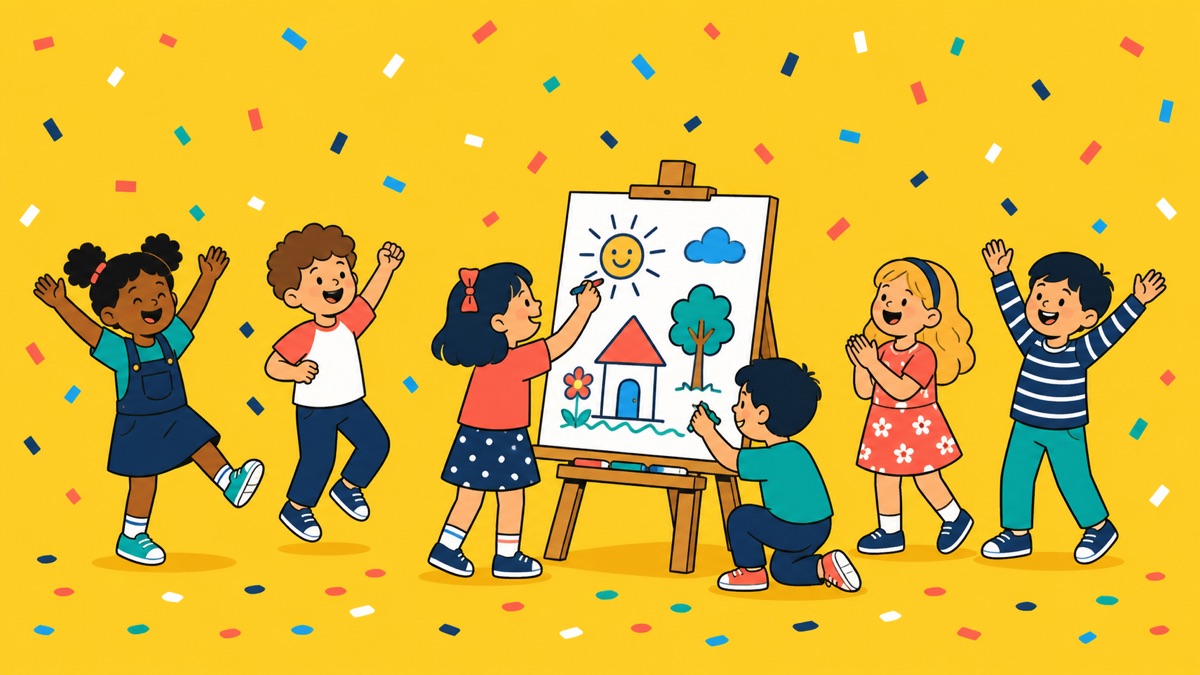
A drawing game can rescue the awkward gap between food, cake, and free play. It needs little explanation, gives shy guests something concrete to do, and produces laughter without requiring anyone to perform alone for long. The best format depends on whether children can read, share devices, wait for turns, and handle competition.
Prepare more than one version. A lively relay may work when guests arrive, while a quiet paper activity can settle the group before food. An online private room can bring structure later. Switching formats is easier than forcing a tired group to stay with a game that has lost its momentum.
Big-paper team draw
Tape large paper to a wall or spread it across a table. Divide guests into small teams and give each team a broad marker. One child draws while teammates guess. Rotate the marker after every clue so that confident artists do not take over.
This format suits younger children because the picture is visible and answers can be spoken. Choose familiar categories and let adults quietly help with reading. Keep score only if the group enjoys it. A shared cheer for every solved picture may work better.
Protect the wall and floor before the party begins. Washable markers, table covers, and clearly marked drawing zones prevent the game from turning into cleanup stress.
Private online room
Create a private Rakuga room and share the link with the guests or their adults. The game works in a browser without an account. Children can join from phones, tablets, or computers, and the room manages drawing turns, chat guesses, and points.
Seat children where an adult can help with controls without reading or revealing the secret word. Use the game chat for guesses and remind guests not to shout the answer after solving it. A shared display can make the action easier to follow, even when players use individual devices.
This format fits children who can type short words and understand turn-taking. For younger guests, pair a child with an older helper or let teams share a device. The helper should type what the child says instead of supplying answers.
Drawing relay
Place paper at one end of the room and teams at the other. A child runs to the paper, adds a useful part of the clue, returns, and tags the next teammate. The team guesses only after each runner comes back. The final picture becomes a group creation.
Use a walking relay indoors if running would be unsafe. Clear the path, keep markers at the drawing station, and avoid slippery surfaces. The movement should add energy without making speed more important than inclusion.
For mixed ages, give younger children the first big shape and older children the later details. Everyone contributes something visible, and no single child carries the whole clue.
Pass-and-add creatures
Each child draws one part of an imaginary creature, folds or covers most of it, and passes the page. The next child adds another part without seeing the full picture. Open the papers together and give each creature a playful name.
This is not a guessing race, which makes it ideal for a calmer part of the party. Children can participate without reading or typing. It also creates a simple take-home item if names are written on the back.
Avoid choosing a winner. The reveal is the reward. Invite guests to point out favorite details without comparing whose drawing is best.
Back-to-back drawing
Pairs sit facing away from each other. One child receives a simple picture and describes it without saying what it is. The partner draws from the description. Then they turn around and compare the images.
Older children often enjoy the communication challenge. Model useful phrases before starting: near the top, beside the circle, under the line, larger, smaller, curved, and straight. Keep the source pictures simple enough that the comparison remains funny rather than discouraging.
Swap roles so both children describe and draw. If a pair struggles, allow questions that can be answered with yes or no.
Memory sketch tray
Place several familiar objects on a tray and show it briefly. Cover the tray, then ask teams to draw everything they remember. Reveal the objects and compare the pictures. The goal is observation and recall, not artistic accuracy.
Choose safe, ordinary party items with different silhouettes. Let younger children name an object while a teammate draws it. Older children can work silently before comparing notes. The same activity adapts without singling anyone out.
Keep the objects in view after the reveal so children can improve one drawing. Revision turns a missed detail into a satisfying discovery.
Silent scene challenge
Give a child a simple situation to show through a scene. The others explain what they think is happening. Answers can be broad because the activity is about storytelling rather than one exact word.
This format works for guests who enjoy imagination more than competition. Encourage the drawer to use setting, faces, movement lines, and object relationships. Afterward, invite the group to build a short story around the picture.
Keep situations friendly and universal. Avoid prompts about personal fears, appearance, family circumstances, or anything that could make a guest feel exposed.
Picture chain
One child makes a quick drawing and passes it to the next. That child writes what they think it shows, hides the drawing, and passes only the words onward. The next person draws the written interpretation. Continue alternating between pictures and descriptions.
The final reveal shows how the idea changed. Children need enough reading confidence for this format, so use it with older groups or provide adult scribes. Remind everyone that strange changes are expected and nobody made a mistake.
Use folded sheets prepared in advance to keep the chain easy to manage. Label the starting owner on the back so each page can return to the right guest.
Plan for different ages
Young children usually need large materials, spoken answers, short turns, and help waiting. School-age children can handle simple team rules, private online rooms, and descriptive challenges. Older children may enjoy more ambiguous scenes and the picture chain, especially when adults avoid over-directing them.
Mixed groups work best in pairs or teams where roles rotate. A young child can choose the idea or make the main shape. An older child can type, read instructions, or add context. Change roles so help does not become control.
Keep the party kind and moving
Explain that rough drawings are part of the fun. Stop teasing that targets a child rather than the picture. Have a quiet alternative ready for anyone who does not want to draw in front of the group. They can guess, help manage materials, or join a collaborative page.
Announce the final turn before attention fades. End with a reveal, a group photo of the paper drawings if families agree, or a simple thank-you. A good party game leaves children wanting another round, not waiting for an activity to finish.
Set up a private party room.
🎨 Play Rakuga