A hard drawing prompt should be difficult for an interesting reason. The challenge may come from showing change, distinguishing close concepts, composing several objects, or making an invisible idea visible. Obscure vocabulary is less satisfying because the guesser cannot solve what they do not know.
These prompts were composed as a general activity list, independent of any game's prompt collection. Use them for adult game nights, creative warmups, team socials, or practice. Every group below explains the source of difficulty and suggests a visual approach.
Abstract ideas
Why they are hard: abstract concepts have no fixed silhouette. Use contrast, symbols, and a short scene that shows the idea affecting someone.
- Patience
- Trust
- Regret
- Freedom
- Jealousy
- Confusion
- Luck
- Privacy
- Responsibility
- Curiosity
- Balance
- Compromise
- Memory
- Possibility
- Belonging
Actions with subtle differences
Why they are hard: a frozen person can suggest many verbs. Emphasize the object, direction, starting state, and result of the movement.
- Borrowing
- Returning
- Hesitating
- Overhearing
- Escaping
- Negotiating
- Interrupting
- Reconsidering
- Imitating
- Preventing
- Discovering
- Misplacing
- Persuading
- Ignoring
- Reuniting
Relationships and social moments
Why they are hard: several people must have clear roles. Use body direction, eye lines, shared objects, and unequal reactions to show who is doing what.
- Awkward introduction
- Secret handshake
- Friendly rivalry
- Unwanted advice
- Group decision
- Shared responsibility
- Broken promise
- Unexpected compliment
- Changing sides
- Silent disagreement
- Welcoming a newcomer
- Missing someone
- Trading favors
- Keeping a secret
- Making peace
Expressions and figurative scenes
Why they are hard: a literal picture may point to the wrong words. Build a compact visual joke and make the important relationship larger than the decoration.
- Walking on eggshells
- Under the weather
- Spill the beans
- Break the ice
- Hold your horses
- Out of the blue
- Piece of cake
- Hit the road
- On thin ice
- Bite your tongue
- Miss the boat
- Face the music
- Open a can of worms
- Take the plunge
- Steal the spotlight
Visual logic puzzles
Why they are hard: the answer depends on sequence, cause, scale, or contradiction. Show a before-and-after relationship or arrange the scene so the viewer knows what changed.
- Shadow pointing the wrong way
- Door that opens nowhere
- Clock running backward
- Reflection doing something different
- Tiny person in a giant room
- Bridge with a missing middle
- Footprints that suddenly stop
- Plant growing through a book
- Umbrella under a rain cloud indoors
- Key that fits no lock
- Staircase returning to its start
- Empty frame casting a shadow
- Map changing while being read
- Candle freezing instead of melting
- Window showing another season
Choose difficulty that stays fair
Tell players the broad theme before a round if the concepts are especially open. Knowing that the answer is an action or expression does not remove the challenge. It gives guessers a useful search area and encourages the drawer to focus on distinctions.
Avoid prompts that depend on private knowledge, niche references, or one culture-specific interpretation unless the whole group shares that context. The most satisfying hard clue becomes obvious in hindsight. Players should be able to see why the picture led to the answer.
Let the drawer skip a prompt that creates discomfort. Social concepts can touch personal experiences, and a party game does not need forced disclosure. Replace it quietly with another item from the same group.
Draw concepts through contrast
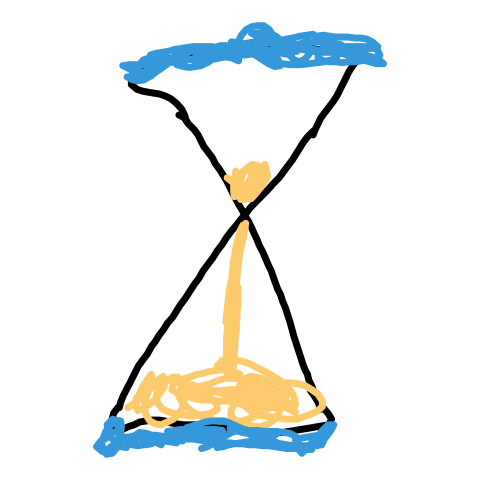
Many abstract ideas become clearer when two states appear together. For patience, show someone waiting while a slow process continues. For regret, show a choice followed by a visible wish to reverse it. For privacy, contrast an enclosed personal space with someone trying to look inside.
Use simple symbols only as support. A heart, lock, question mark, or thought bubble can establish a direction, but the surrounding scene should explain the specific concept. Symbols alone often produce a cloud of related guesses.
Draw actions through cause and result
A single pose may not separate borrowing from taking or returning. Show an object moving between people, then indicate the expected direction or later state. Repeated figures can represent the same person at different moments if clothing or position stays consistent.
For subtle communication verbs, exaggerate faces and attention. Overhearing needs a speaker, an unintended listener, and a line of sound. Ignoring needs a clear signal aimed at someone who turns away. The relationship is the clue.
Make expressions solvable
Figurative prompts invite literal pictures, but the composition must highlight the unusual combination. For walking on eggshells, the careful feet and fragile path matter more than the background. For stealing the spotlight, show attention moving from one performer to another.
Do not write any part of the phrase. If the literal scene produces many synonyms, add a character reaction or stage the familiar relationship more clearly. A concise visual joke usually works better than several disconnected symbols.
Recover from a stalled round
When guesses stop, identify which layer is missing: category, action, relationship, or result. Add that layer instead of redrawing faces or outlines. A visible destination can explain movement. A second character can explain motive. A before-and-after panel can explain change.
Hard prompts reward planning. Before drawing, decide the easiest wrong interpretation and one detail that eliminates it. Keep the scene large, limit extra objects, and treat wrong guesses as feedback about what the picture currently communicates.
The purpose is not to make the answer impossible. It is to create the delayed click when several rough marks suddenly connect. Choose familiar language, build a clear visual argument, and let difficulty come from ideas rather than trivia.
Challenge friends in a private room.
🎨 Play Rakuga