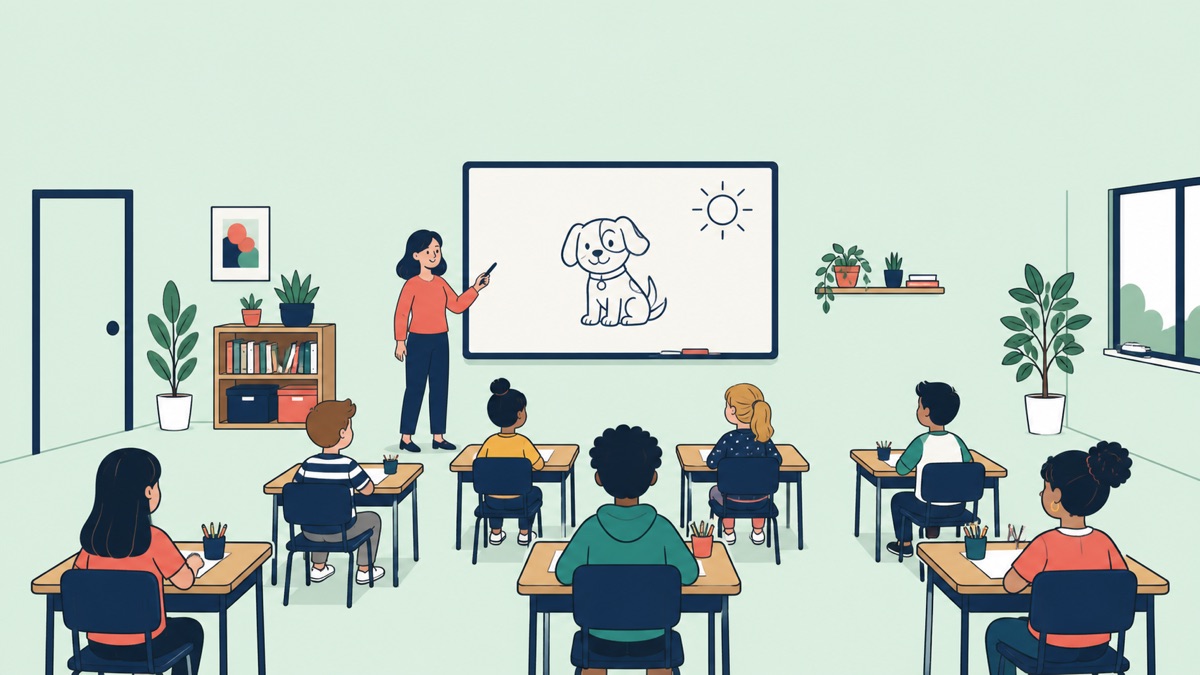
A drawing and guessing game works well in a language class because meaning has to travel without translation. The drawer converts a word into a visual clue. Classmates retrieve possible words, test them, and revise their guesses. The activity feels playful, but the language task is precise: learners connect form, meaning, context, and rapid recall.
The key is to design the game around the lesson rather than use it as unstructured free time. Choose a narrow vocabulary goal, explain what counts as a fair clue, and keep each turn short. Rakuga works in a browser without an account, so a teacher can create a private room and share the link with the class. Learners can join from a computer or phone.
Set one language goal
Begin with a single purpose. A lesson on household objects can focus on concrete nouns. A unit on movement can use verbs. More confident learners can work with adjectives, compound phrases, or words that require a scene. A clear theme makes guesses more productive because students search within a useful vocabulary field.
Avoid giving a giant list at the start. Preview a small set through examples, pronunciation, or a sorting activity, then use drawing to retrieve the language from memory. After the game, bring back the words that caused confusion. Ask what visual feature made each one clear or misleading.
A routine for beginners
Beginners need permission to use simple English and to make imperfect guesses. Put a few sentence frames where everyone can see them: “Is it a…?”, “I think it is…”, “Draw the…”, and “It looks like…”. During play, accept the target word in the chat, then use the frames for a brief spoken follow-up.
Choose concrete items with distinct shapes and familiar settings. Before the game, model how context helps. A plain circle has many meanings, while a circle in the sky with rays gives a clear category. A cup beside a plate is easier to read than an isolated curve. The lesson is not artistic technique. It is how details carry meaning.
Pair learners before the whole-class round if they are hesitant. One partner can suggest an English guess while the other types it. Swap responsibility regularly. This lowers the pressure of public production while still requiring both partners to attend to the clue.
A routine for intermediate learners
Intermediate learners can handle broader categories and short explanations. After a correct guess, ask the drawer to describe the clue using simple sequence language: first I drew the object, then I added the place, finally I showed the action. Guessers can explain which mark changed their minds.
Add a paraphrase phase before drawing. Show the drawer the target and ask for a spoken definition that does not contain the word. Then begin the visual round. The class hears one semantic route and sees another. If the definition reveals too much, keep it for the reflection after the answer.
Use contrast pairs to sharpen meaning. Words such as lend and borrow, arrive and leave, or empty and full are often confused. Put related targets in separate rounds, then compare the drawings. Students can discuss which visual relationships made the direction or state visible.
A routine for advanced learners
Advanced learners benefit from concepts that cannot be represented by one object. Actions, feelings, social situations, and idiomatic scenes force the drawer to compose relationships. Guessers must interpret intention rather than name an item. Keep the vocabulary tied to language the class is already studying so difficulty comes from communication, not surprise.
After each challenging round, ask learners to propose a better clue sequence. They might argue that the drawer should have established the setting before the person, or that a contrast scene would have clarified the concept. This turns the game into discussion about explanation, ambiguity, and audience awareness.
A useful extension is a short retelling. The class describes the finished picture as a scene using the target vocabulary. Different learners may notice different details, giving the teacher a natural way to work on articles, prepositions, verb forms, and descriptive order.
Manage the room without losing momentum
Use a private room when the activity belongs to one class. Share the link through the channel students already use and ask everyone to join with a recognizable classroom name. Establish the rule that the chat is for relevant guesses and supportive reactions. The game has no voice chat, so spoken discussion stays in the classroom or the call.
Decide how devices will be used. In a room with shared tablets, small groups can play as teams. In a computer room, each learner can join individually. With one display, the teacher can show the room while teams write possible answers on paper and a nominated typist submits them.
Keep waiting time active. While one learner draws, everyone else should be guessing. After an early correct answer, ask successful guessers to note the clue that helped without saying the solution aloud. That reflection can be shared after the turn. Students remain involved without giving away the word.
Support learners who dislike drawing
State clearly that recognizable beats beautiful. Demonstrate a weak but effective sketch made from basic shapes. Show how a stick figure, arrow, container, or location line can communicate a relationship. Praise decisions that helped the audience, not visual polish.
Offer planning prompts: What is the category? What feature separates this word from similar words? Where would someone see or use it? The drawer can answer privately before touching the canvas. This makes the task feel like solving a communication problem instead of performing art.
If a learner freezes, let them begin with context. A kitchen, road, classroom, or park narrows the field before the central object appears. Another option is to draw the action around the target. A hand opening something may be clearer than the object alone.
Make feedback language-focused
Do not correct every chat typo while the round is moving. Fast guessing is fluency practice, and interruption can flatten the energy. Collect recurring issues and address them between activities. If spelling matters for the lesson, display the correct form after the answer and have the group say or use it.
Review difficult rounds with three questions: What did we think first? Which clue changed our interpretation? What could make the answer clearer next time? Learners practice explaining thought processes and notice that communication improves through revision.
Finish with retrieval away from the game. Students can categorize the words, write a short scene using them, or describe one memorable drawing to a partner. The game creates vivid shared references. The follow-up turns those references into language learners can use again.
A ready lesson flow
Open with a quick vocabulary preview. Model one drawing and think aloud about category and context. Let learners play a compact set of themed rounds, pausing only when confusion offers a useful teaching moment. Follow with partner explanations and a short written task. End by asking which visual clues were most efficient and why.
A well-run drawing game gives quiet learners a concrete reason to contribute, confident learners a challenge in precise explanation, and the whole class a shared problem. Keep the target narrow, the expectations kind, and the reflection specific. The drawings can be rough. The language work should be deliberate.
Create a private room for your class.
🎨 Play Rakuga